🎃 Halloween Sale – 7% OFF Code: SPOOKY7 | Free Shipping 👻



Awake or Sleeping Reborn Dolls: Choose the Expression You Want to Live With

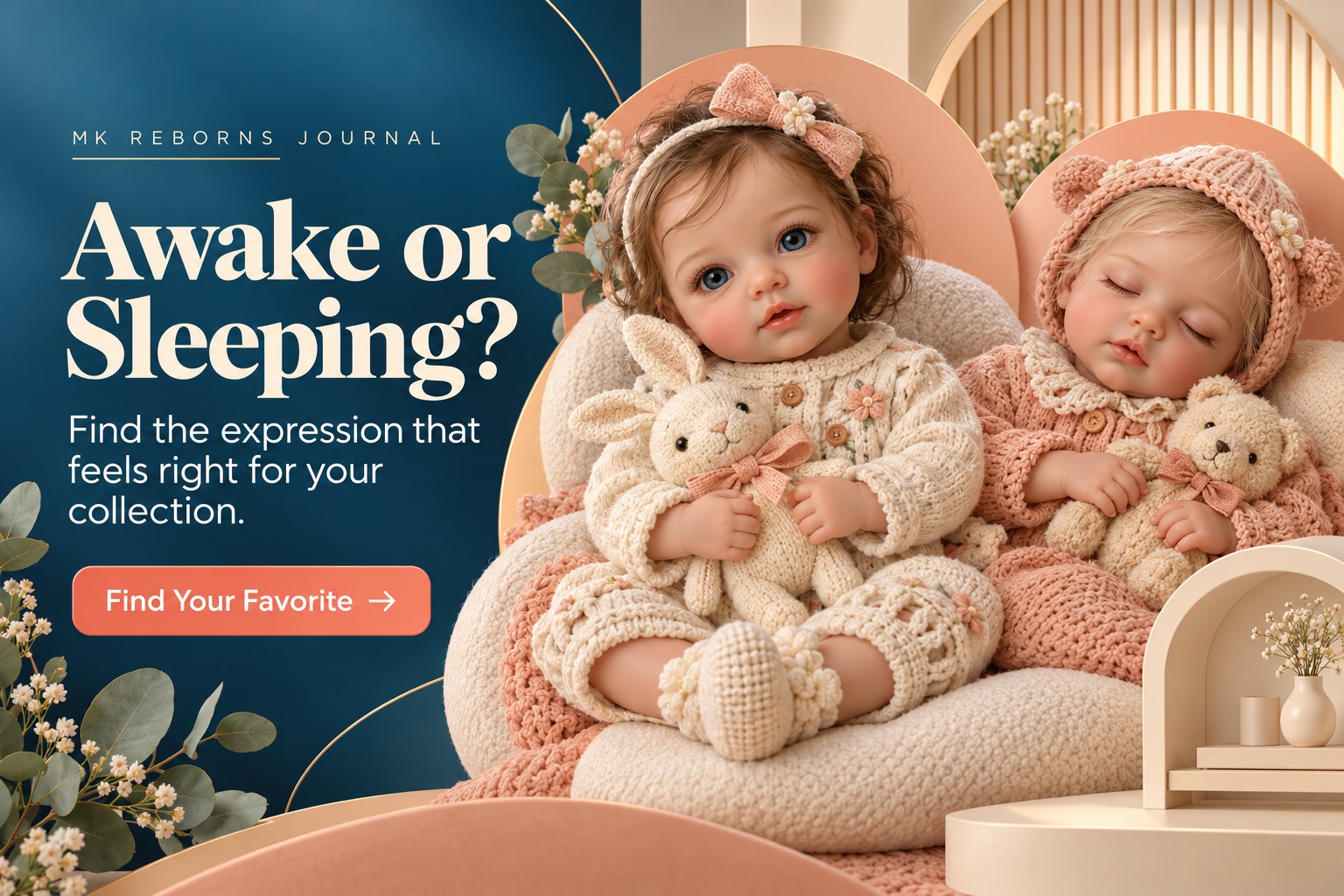
A sleeping reborn doll has a sculpted resting expression, while an awake reborn doll has an open-eyed expression. Those words describe an appearance, not a promise that the eyes move. For most buying decisions, the useful question is not which expression is more realistic in general. It is which face you enjoy in the positions, light, and everyday moments that will make up your own collection.
You may notice a sleeping face first because it feels peaceful. You may keep returning to an awake face because its gaze gives a display a particular presence. Neither response needs defending. A collectible can be carefully made and still not be the right choice for you. This guide helps you separate that personal response from practical questions about photographs, positioning, materials, and the information a seller should provide.
Start with the expression, then verify the actual product. An attractive face cannot tell you the body construction, dimensions, weight, care requirements, or included accessories. You can explore the Mk Reborns shop alongside this guide, but use the details of each individual listing rather than assuming that every doll in a photograph has the same construction.
Begin with one ordinary moment
Imagine the doll on a normal afternoon rather than in a dramatic unboxing. Where would you see it? Perhaps you have a quiet display shelf beside a reading chair. Perhaps you enjoy changing an outfit, arranging a photograph, and then putting the doll safely away. Perhaps your favorite part of collecting is seeing different sculpted expressions together. These are different ways of enjoying the same hobby, and they can lead to different choices.
Write a sentence that finishes this thought: I want to see this doll most often when I am doing this. Be specific. A sleeping newborn arranged in a supported resting position may suit a quiet display. An awake expression may suit photographs in which the face appears to notice a small book or another doll. These are suggestions about visual storytelling, not rules about how a collector must behave.
Avoid choosing for an imagined audience before choosing for yourself. A face that receives enthusiastic comments online may not be the face you want to look at each day. Conversely, a sculpt that looks understated in a crowded feed may feel exactly right in your own space. Return to the listing after a break and see whether the same details still matter to you.
What awake and sleeping actually tell you
Awake generally means that the doll is presented with open eyes. Sleeping generally means that the eyelids appear closed. These labels do not, on their own, establish whether the eyes are inserted, painted, fixed, or movable. They also do not tell you whether a doll has an electronic function. Treat every movement or sound claim as a separate feature that needs explicit confirmation in the product description.
A closed-eye sculpt should not be treated as a doll waiting to have its eyes opened. An open-eye doll should not be assumed to close its eyes when laid down. Do not press an eyelid or attempt to reposition an eye to test a feature that the seller has not described. If you want a movement feature, ask about that exact function before purchasing and request the relevant instructions.
The expression is also separate from the material. Sleeping and awake appearances can exist across different constructions. A material label does not automatically predict the face you will prefer, and a face does not establish the material. The vinyl and silicone material guide can help you organize those questions without combining them into one vague idea of realism.
Read the whole expression rather than only the eyes
Eyes attract attention, but cheeks, mouth, brows, and head angle also shape your response. Two closed-eye dolls can convey very different impressions. One may look settled, another mid-stretch, and another as though it is making a small sound. Two awake dolls can differ just as much, even if their eye color is similar. Describe the whole face in your own words before deciding that you prefer an entire category.
Try three neutral descriptions rather than a rating. You might write relaxed mouth, slightly turned head, and softly lowered brows. Another doll might have an open mouth, a direct gaze, and fuller cheeks. This small exercise makes comparisons more useful because you are identifying visible features. It also helps you ask a seller a precise question instead of asking whether a doll looks real.
Notice which features remain appealing when you look beyond the styling. A hat, blanket, or carefully chosen camera angle can strongly influence a first impression. Look for a clear view of the face with minimal obstruction. If the only picture hides the eyebrows or shows the face from far above, ask for another view rather than assuming that the missing detail matches your expectation.
Sleeping expressions and the appeal of a resting scene
A sleeping expression can make a resting arrangement feel visually coherent. The closed eyelids do not need to appear directed toward an object, so the scene can be simple: a supported head, an uncomplicated outfit, and a quiet background. For a collector who enjoys subtle facial sculpting, the mouth and cheeks may become the details that hold attention.
That does not mean every sleeping doll will feel soothing to every person. A particular mouth shape or brow line may suggest a different mood to you. Personal associations vary, and photographs can intensify them. If you find yourself repeatedly trying to explain away an expression that bothers you, pause. A purchase does not become a better fit simply because another collector loves the same sculpt.
Consider the display position as well. A resting face may be your favorite close up but feel less natural to you in an upright arrangement. You do not have to copy the pose in a sales photograph. Ask whether the body can safely be supported in your intended position, and follow the product instructions. The right expression and a suitable physical arrangement should work together.
Awake expressions and the importance of gaze
An awake expression can give a display a sense of attention. The face may seem directed toward the viewer, slightly past the viewer, or toward something in the scene. That effect depends on the sculpt, eye placement, head angle, and camera position. It is worth viewing more than one angle before deciding how the gaze will feel in your home.
Look at the face straight on, then from both sides if those images are available. You are not trying to diagnose a manufacturing problem from a photograph. You are checking whether the expression consistently appeals to you. A reflection on the eye surface can look different under different lighting, so ask for an unfiltered photograph in ordinary light if the listing leaves you uncertain.
Do not assume that changing eye color will solve an expression you dislike. Color, placement, sculpting, and lighting interact, and customization may not be offered for the product. If a seller offers options, confirm what can actually be changed and whether the images represent that option. A promised variation should be described clearly before it becomes part of your buying decision.
Compare photographs under similar conditions
A fair comparison uses similar views. If one candidate has a softly lit close-up and another has only a distant photograph with a flash, you are comparing photography as well as the dolls. Build a short list of missing views: a front portrait, a three-quarter portrait, the full body in a supported position, and a view of the item as it will actually be supplied.
You do not need a professional camera to ask for useful evidence. A clear, current photograph in ordinary light can answer a question that a heavily styled image cannot. Ask whether the photographs show the exact item, a representative sample, or a customized example. Those are different kinds of evidence, and the distinction matters when painted details or styling vary.
Screens also alter color and contrast. Compare images on the same device at a comfortable brightness, and avoid treating tiny color differences as precise measurements. If a feature is essential to your choice, describe it and ask for confirmation. A written answer about eye color or the supplied outfit is more useful than relying on a color impression from one screen.
A small decision table for your shortlist
| Your main preference | What to examine | Question to ask |
|---|---|---|
| A quiet resting display | Eyelids, mouth, supported pose | Is this the actual face and body construction supplied? |
| An attentive portrait | Gaze from several angles | Can I see an unfiltered front and side view? |
| A movable-eye feature | Explicit feature description | Do the eyes move, and where are the instructions? |
| Easy occasional styling | Body and hair care instructions | Which handling and clothing changes are suitable? |
| A gift for a collector | The recipient's own preferences | Can the recipient choose the expression before ordering? |
Use the table to identify unanswered questions rather than to award points to one type. A missing answer is not a reason to invent a favorable assumption. Keep the candidate on hold until the detail is clear. If two dolls meet your practical requirements, your preference for one face can be the deciding factor without a complicated scoring system.
Keep size and body construction in the decision
A close-up removes scale. A face that fills your phone screen could belong to a small collectible or a much larger doll. Read the measurements and ask how they were taken if that affects clothing, storage, or display. Do not infer the size from a prop unless its dimensions are known and the photograph makes the comparison meaningful.
Body construction influences what a pose looks like and which handling methods are appropriate. A photograph alone may not reveal whether the torso is cloth or another material. Check the product specification rather than assuming that a visible arm tells you everything about the body. If your preferred display involves a particular outfit, confirm that its cut suits the actual construction.
Weight is another separate question. An expression may look delicate while the physical doll feels different from what you expect. Where weight is important, ask for the listed weight and what it includes. Avoid choosing a weight simply because someone else describes it as realistic. Your comfort and the suitability of the display space matter more than matching another collector's preference.
Think about hair without reopening every decision
Hair can change how you perceive a face, but it should not turn a focused decision into an endless comparison. First identify whether the facial expression appeals to you. Then check whether the supplied hair finish matches the amount of styling and care you want. A photograph with a hat is not a substitute for a clear description of the hair.
If hair is the unresolved part of the decision, use the separate painted or rooted hair guide. Keeping the questions separate makes it easier to understand a tradeoff. You might prefer the face of one doll but the hair finish of another; that is useful information, not a reason to assume that either can be altered.
Ask about the actual item rather than requesting a general promise of low maintenance. Care depends on materials and construction. If you want to change hats or outfits frequently, explain that intended use and request relevant guidance. A seller can answer a concrete handling question more clearly than a broad question about whether a doll is easy to own.
Plan a display before buying accessories
Choose a stable, suitable space and consider where the light falls during the day. A spot that looks beautiful for a short photograph may not be appropriate for ongoing display. Follow the product's guidance on sunlight, heat, contact materials, and support. Do not assume that a soft-looking surface or a familiar household item is automatically suitable for prolonged contact.
Then imagine the expression in that setting. An awake face viewed from a high shelf may appear different from the same face held at eye level. A sleeping face may look especially natural in a supported resting arrangement. You can sketch the intended position or measure the available space before purchasing a collection of props that might not work.
Keep the first arrangement simple. Too many accessories can hide the face you chose and make safe support harder to assess. Start with the doll and the minimum appropriate support, then add a small number of compatible items. The reborn doll care page is a useful place to organize care questions, while the instructions supplied with the specific product remain the reference for handling it.
When the doll is a gift
Expression is a personal choice, so a surprise can introduce unnecessary uncertainty. If the recipient already collects dolls, ask which faces they return to and which expressions they avoid. A person who owns several sleeping dolls may want another, or may be deliberately looking for an awake expression. The existing collection is a conversation starter rather than proof of what to buy.
You can preserve the warmth of a gift while sharing the selection. Offer a short list, invite the recipient to choose the expression, or make the experience of choosing part of the present. Confirm the practical limits together, including budget, dimensions, and any delivery requirement. Do not promise a deadline that the seller has not confirmed for the destination and item.
If the recipient is a child, do not use the appearance of the doll to decide age suitability. Collector pieces and play products can have different intended uses and components. Read the exact age guidance and safety information for that product. An awake face is not evidence that a doll is a toy, and a sleeping face is not evidence that it is suitable for a younger child.
A useful message to send before ordering
Keep your message short enough to answer clearly. You might write: I am interested in this specific doll and prefer the expression shown in the front photograph. Please confirm whether the eyes are fixed or movable, whether the photographs show the item or a sample, and which body construction and hair finish are supplied. Could you also confirm the dimensions and included accessories?
If a detail matters because of your intended use, explain that reason. For example, say that the doll will sit in a supported display rather than asking whether it can be posed in any position. Or say that you want a clear front portrait in ordinary light because you are comparing the gaze. Specific questions reduce the chance of receiving a reassuring but uninformative answer.
Save the response with the listing details you used to decide. This gives you a straightforward reference when the parcel arrives and helps you distinguish an expectation from a confirmed specification. It is also useful if you later contact the seller with a question. Keep private order information separate from photographs or notes that you share publicly.
Three examples of a thoughtful choice
Consider a collector who enjoys quiet portrait photographs but rarely changes outfits. They might shortlist a sleeping expression, then verify the hair finish, body construction, and safe support. Their decisive question is whether the face feels right in an ordinary resting view. They do not need to choose an awake doll simply because it offers a different kind of photograph.
Another collector enjoys arranging a small scene with a book or a second doll. They might prefer an awake expression and request several views of the gaze before ordering. Their practical questions include the intended supported position and whether the supplied outfit works for that scene. They should not assume that the doll can hold a prop or maintain a pose without appropriate support.
A third collector loves a particular face but cannot decide whether the eye style suits them. Rather than buying immediately, they save the listing and return later. If the same uncertainty remains, they ask for an additional photograph or choose a different candidate. Waiting is a valid part of collecting. There is no requirement to turn every appealing image into a purchase.
Make a shortlist that is small enough to use
Save no more candidates than you can compare carefully. A folder containing dozens of faces can make every choice feel temporary. Begin with three that fit your practical limits. For each one, record the exact listing address, the expression you like, and one unresolved question. Keep observations separate from confirmed specifications. For example, looks gently sleepy is your impression; fixed closed eyes is a specification only when the seller confirms it.
Next, remove the styling from your written description. Instead of the doll in the blue knitted outfit, write the doll with the slightly turned head and relaxed mouth. This helps you notice whether you love the face or mainly the presentation. There is nothing wrong with enjoying styling, but an outfit may be optional, unavailable, or different from what is included. Your decision should remain understandable when that prop is absent.
Finally, check the listing again before ordering. Availability, supplied options, and terms can change. A saved screenshot is useful for your notes, but the current listing and the seller's confirmation are what you should use for the purchase. If an essential answer remains unclear, keep the shortlist rather than rushing to complete it. A thoughtful collection grows through considered choices, including choices to wait.
Questions collectors often ask
Can a sleeping reborn doll open its eyes?
Only assume this if the specific product description explicitly confirms a movable-eye feature. The word sleeping usually describes the visible expression. Do not try to open sculpted eyelids or modify the face. If eye movement is essential, ask the seller to identify the feature and provide the correct instructions before you order.
Are awake dolls more realistic than sleeping dolls?
There is no universal answer. Realism is affected by sculpting, finishing, gaze, lighting, and presentation, and your own preferences matter. Compare the actual candidates in similar photographs and in the setting where you plan to enjoy them. One expression may suit a resting scene while another suits an attentive portrait.
Does a closed-eye doll need less care?
You cannot determine the care routine from the eye expression alone. Materials, paint, hair, eyelashes, body construction, and accessories all matter. Follow the instructions for the specific doll. Do not introduce a cleaning product, adhesive, or handling method merely because another collector used it successfully on a different item.
Can I change the eyes after buying?
Do not assume that a finished doll is designed for owner modification. Ask the seller about any offered customization before purchase. Altering a finished item can affect its appearance, condition, and applicable return terms. If the eye appearance is central to your decision, choose a product whose confirmed specification already meets that preference.
What if I like both expressions?
You do not have to declare a permanent preference. Choose the face that fits the collection and space you have now, and let a future purchase be a separate decision. If both candidates meet your practical requirements, spend some time with their ordinary photographs. The face you keep returning to is useful information.
What should I check last?
Before ordering, confirm the exact item or selected variation, dimensions, construction, eye behavior, hair finish, included items, care guidance, and applicable shipping and return terms. Read those terms directly rather than relying on a search snippet. Once the practical details are clear, choose the expression you will enjoy seeing in your own everyday collection.