🎃 Halloween Sale – 7% OFF Code: SPOOKY7 | Free Shipping 👻



Painted or Rooted Hair? Choose a Reborn Doll for the Way You Will Enjoy It

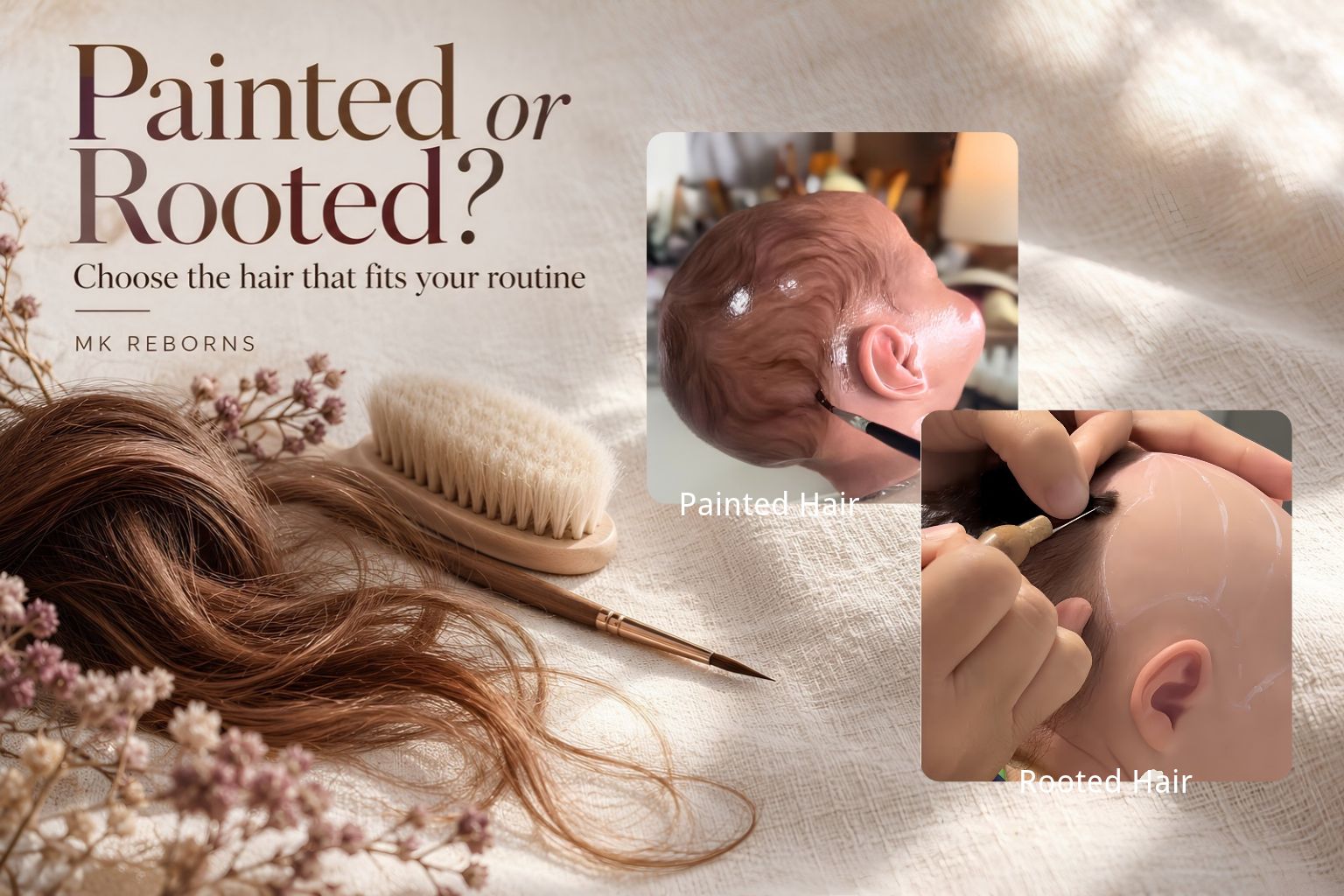
The short answer: Painted hair is a visual finish without loose strands to arrange. Rooted hair adds actual fibers that can change the silhouette and may allow gentle styling within the maker instructions. Neither choice is automatically more realistic or more valuable. Choose by the appearance you enjoy, the amount of handling you expect and the care you are willing to provide. Confirm the exact hair treatment on the specific doll before ordering.
Sometimes the detail that makes a reborn doll feel right is very small: a quiet sweep across the forehead, a delicate crown or a little curl beside an ear. That detail can be easy to fall in love with in a photograph and harder to evaluate in a product description. Words such as realistic, soft and newborn do not tell you whether the hair is painted, rooted, attached as a wig or represented by a smooth bald sculpt.
Before comparing dolls, picture an ordinary afternoon with your collection. Will the doll remain in a display basket, be gently held during a quiet moment or change outfits for photographs? A beautiful finish that suits one routine may feel unnecessarily demanding in another. This guide focuses on that everyday decision rather than ranking one type of hair above all others. It will help you make a clear shortlist and ask useful questions without needing to become a doll artist.
In this guide
Start with the hair treatment, not the adjective
Painted hair creates an image of hair on the head
Painted hair uses color and fine marks on the surface to suggest individual hairs, a hairline and the direction of growth. The effect depends on the painting, the sculpt and the way light reaches the head. It can suit a very fine newborn appearance, including a delicate crown that would be difficult to judge from a distant photograph. Because there are no separate strands in that painted area, there is nothing there to brush into a different part.
This does not make painted hair maintenance free. It remains part of the surface finish, so rubbing, abrasive accessories or unsuitable cleaning products can still be a concern. Ask how the maker recommends protecting the painted head. A cap that fits the circumference but drags tightly across the paint is not automatically a good accessory. If you want to change the appearance often, remember that a different hairstyle would generally mean artwork or specialist alteration, not a quick brush.
Rooted hair adds individual fibers to the head
Rooted hair describes fibers inserted into the head. Listings may identify the fiber as mohair, synthetic hair or another material, but the word rooted alone does not specify the fiber, density or method of securing it. Those details matter when evaluating softness, the visible hairline and suitable care. A full head of hair and a very sparse newborn head can both be rooted, while producing completely different impressions.
Rooted hair can make a silhouette look softer and may respond to gentle arrangement. That possibility should not be confused with permission to brush vigorously, wet the head or apply human hair products. The material of the head and the maker instructions remain important. If a listing says the doll has rooted hair but provides no care information, ask for that information before deciding. A buyer should not have to discover the limits by experimenting on a finished doll.
Combination hair and wigs need their own questions
Some dolls combine painted detail with rooted fibers. For example, painted areas may visually support a sparse rooted style. Ask which parts are painted and which contain fibers so you can understand the photographs accurately. A combination can be attractive, but it does not inherit every advantage of both methods without tradeoffs. You still need to protect the finish and follow the instructions for the fibers.
A wig is different again: hair is attached as a separate hairpiece rather than described as individual rooting into the head. Do not assume a wig can be removed simply because it is a separate component. Attachment methods vary, and removal may damage the surface or affect any return eligibility. A smooth bald head is also a deliberate aesthetic choice. It can be especially appealing when you love the shape of the sculpt or the quiet appearance of a very young baby.
| Listing description | What to establish | Do not assume |
|---|---|---|
| Painted hair | Hairline detail, crown view and surface care | That the finish cannot be rubbed or marked |
| Rooted hair | Fiber type, density, attachment and permitted care | That all brushes, water or conditioners are suitable |
| Combination hair | Where paint ends and rooted fibers begin | That every visible hair in a photo is a loose strand |
| Wig | Attachment and whether any restyling is permitted | That the hairpiece is removable |
| Bald | Head finish and the exact appearance in normal light | That hair can be added later without specialist work |
Make the choice around an ordinary day
If you enjoy holding your doll frequently
Think about the places where the head will rest: your sleeve, a blanket, a cushion or the inside of a carrier used for your collectible. With rooted hair, repeated contact can move fibers out of their arranged position. With painted hair, the visual arrangement stays fixed, although the surface still needs gentle treatment. The useful question is whether you enjoy making small adjustments afterward or would prefer a finish without loose strands.
You might find painted hair a practical preference if you want to pick up the doll and enjoy the moment without thinking about the hairstyle. Another collector may find gently arranging rooted hair part of the pleasure. Neither response is more authentic. Choose the routine you actually want, not the routine that seems most impressive in a collection photograph. A doll that feels easy to enjoy is more likely to remain a meaningful part of your collection.
If your favorite activity is changing clothes
Changing outfits brings fabric close to the face and head. Narrow neck openings, rough seams and fasteners can catch fibers or rub the finish. Consider clothes that open widely and can be moved without dragging across the head. A hair choice does not remove the need for a careful dressing method, and the size printed on clothing is only a starting point. The sculpt and body proportions determine the actual fit.
Before ordering several outfits, check the measurements described in our reborn doll clothing size guide. If you expect frequent changes, ask the seller whether the proposed outfit opening is appropriate for that particular doll. Buying one well-fitting outfit first can be more useful than buying a large set that requires awkward handling. Hair care and clothing fit work together in this decision.
If your collection is mainly for display
For a display doll, the viewpoint may matter more than the opportunity to style the hair. A doll sitting low in a basket is often seen from above, making the crown important. A doll placed on a shelf may be viewed mostly from the front or side. Ask for a photograph from the angle you will actually see. A listing that shows only a bonnet and a front portrait leaves a significant part of the decision unanswered.
Consider the environment as well as the hairstyle. Direct sunlight, dusty surfaces and repeated friction from props are separate concerns from the distinction between painted and rooted hair. Follow the maker guidance for the entire doll. If a display requires a tight hat to achieve the look you want, ask about fit rather than forcing it. An attractive display should support the collectible without hiding information you needed before buying.
If you take close-up photographs
Close-up photography can reveal details that are less obvious at normal viewing distance. Rooting direction, visible fibers and the transition at the hairline may be central to your preferred style. Painted strokes may look particularly effective from one distance and more visibly artistic in a macro photograph. That is a difference in presentation, not proof that one doll is incorrectly made. Compare examples photographed under similar conditions.
Think about whether you want repeatable portraits or changing hairstyles. Painted detail provides a stable arrangement across images. Rooted fibers may offer variation, within the limits of the doll and its care instructions. If you plan to publish photographs, avoid assuming a seller image guarantees the exact result from your camera. Lens choice, exposure, background and light direction can alter the apparent color and density of hair considerably.
Ask for a small set of revealing photographs
A useful photo set does not need elaborate styling. It needs to answer specific questions. Request a front view with the head uncovered, a side view that shows the hairline, a clear view of the crown and a normal-distance photograph of the whole doll. These views make it easier to understand how the hair belongs to the overall sculpt. They also reduce the temptation to judge a doll by one carefully arranged portrait.
Read the hairline and crown separately
At the hairline, look for the appearance you personally prefer: a very soft sparse edge, a defined fringe or an intentionally fuller style. At the crown, look at the direction and distribution of the visible detail. Do not use a single universal density rule. Different ages, sculpt styles and artistic choices create different effects. Instead, ask whether the appearance remains consistent with the product description and the photographs from other angles.
For rooted hair, a close view can help you see the distribution of fibers, but it may not establish exactly how they are secured inside the head. For painted hair, a close view can show brushwork, but it cannot prove how the finish will respond to a particular product. Recognize the limits of photographs. Questions about construction and care belong in a written answer from the seller or maker.
Compare normal light rather than filters
Soft daylight or neutral indoor light can help you compare tones more clearly than strongly colored lighting. Ask whether the photographs have been edited in ways that alter the hair or skin appearance. You do not need to accuse a seller of misleading you; a simple request for a clear, unfiltered reference image is practical. A warm lamp can make brown fibers look more reddish, while bright exposure can hide the lightest painted strokes.
If the seller offers several versions, check that the photo and written selection refer to the same one. A listing may show alternatives with different hair, clothing or eye appearances. Save the selected option and its description before ordering. This is especially helpful when a product gallery includes both promotional images and photographs of individual dolls. The image you love should correspond to the item or variation you are actually choosing.
Distinguish the actual item from a representative image
Ask whether the images show the exact doll for sale or a representative example. With individually finished items, small differences may be part of the process. With a standard product listing, the seller should still explain any expected variation. A request for clarity is not a request for perfection. It helps you understand what is promised and what is illustrative before money changes hands.
Keep a simple comparison note for each candidate: treatment, stated fiber, confirmed views, permitted care and unanswered questions. If one candidate has beautiful photographs but almost no information, do not fill the gaps with assumptions. An unanswered question remains unanswered even when the doll is emotionally appealing. Giving yourself a little time to verify details can protect the pleasure of welcoming the doll into your collection.
Keep hair, body material and overall realism separate
A realistic photograph combines many features: sculpt, proportions, surface color, eyes, pose, clothing and light. Hair is only one part. A doll with rooted hair is not automatically more lifelike than a doll with carefully painted hair, and an expensive material does not guarantee the hair treatment you prefer. Evaluate the actual item as a whole, then return to the details that will affect your daily enjoyment.
Body material is a separate choice. The phrase silicone doll does not, by itself, specify the hair method, the construction of every body part or whether the doll may be immersed. If you are also comparing materials, use the vinyl and silicone material guide as a starting point, then confirm the individual listing. Do not carry care instructions from one material or one maker to a different doll.
It is also helpful to separate visual realism from play suitability. A collector doll can look exceptionally lifelike while requiring delicate handling. Rooted hair, painted surfaces and small accessories each raise product-specific questions. Follow the stated intended age and instructions; appearance alone cannot establish that a doll is suitable for a child. If you are buying for another person, involve them in the choice where possible instead of assuming the most detailed item is the best match.
A message you can send before ordering
Specific questions usually produce more useful answers than asking whether a doll is good quality. You can adapt the following message to the product you are considering. Include the product link and selected variation so there is no confusion about which doll you mean.
Hello, I am considering this doll and would like to confirm the hair details. Is the hair painted, rooted, a combination or a wig? If it is rooted, what fiber is used and what care do you recommend? Do the photographs show the exact item or a representative example? Could you show the uncovered front hairline and crown in ordinary light? I expect to handle the doll gently and change outfits occasionally, so I would also appreciate any advice about clothing or hats that could affect the finish. Thank you.
Read the answer for practical clarity. A useful reply identifies the treatment and explains what the owner should do or avoid. A reply that only repeats soft, premium or realistic has not resolved the question. If a particular care method matters to you, ask about it directly. For instance, you may want to know whether any dampening is permitted, rather than assuming the answer from a video featuring a different doll.
For a Mk Reborns product, use the contact page with the exact product link. Browse the lifelike reborn doll collection to build a shortlist, then confirm details on each individual listing. Category membership is not a substitute for product specifications. Keep written answers together with your order information so the instructions remain easy to find later.
Budget for the finished experience
When comparing prices, include the information and support you need as well as the doll itself. You may prefer a straightforward finish with clear instructions over a more elaborate hairstyle that leaves you uncertain about maintenance. Do not assume a higher price proves a specific technique or a lower price proves a defect. Compare the actual description, the photographs, the included items and the applicable shipping and return terms.
Accessories can quietly change the total cost. A bonnet, display cushion or additional outfit may be optional rather than included. Make a short list of what you genuinely need for the first week and postpone the rest. This gives you time to learn the proportions of your doll and avoids buying items that do not fit. The most satisfying collection does not have to begin with every accessory at once.
Be cautious about planning a future hair conversion as part of a bargain. Adding rooted hair to a finished head or changing an existing finish can require specialist assessment and may not be suitable. The cost, material compatibility and risk cannot be established from a general buying guide. If you already know you want a particular hair treatment, look for a doll that has it rather than assuming a later alteration will be simple.
When the doll arrives, observe before adjusting
Open the package on a clean, stable surface and keep the packaging while you check the item. Compare the selected variation, included accessories and visible hair treatment with the order information. Take a few clear photographs before changing the arrangement. This gives you a useful reference and makes it easier to communicate any question to the seller without relying on memory.
Packaging may press loose fibers into a temporary position. That does not mean you should immediately wash or brush them. Read the supplied instructions first and ask if the appearance concerns you. With painted hair, inspect the surface in ordinary light without rubbing it as a test. If you see an issue, document it and contact the seller before attempting a repair or alteration that could complicate assessment.
Make the first clothing change slowly, if you choose to make one at all. Support the doll according to its construction and avoid pulling fabric tightly over the head. Put aside accessories that catch or require force. Our reborn doll care page offers a general reference, but the written instructions for your specific doll take priority. General advice should never override a maker restriction.
Three decisions without a universal winner
The quiet daily companion
You want a doll that you will gently hold often, and styling is not part of the appeal. Start by comparing painted or bald options, then examine their surface finish and care requirements. You may still fall in love with a rooted doll, but make that choice with a clear understanding of the additional fiber care. The point is to align the choice with your routine, not to exclude a style because someone else prefers another.
The portrait project
You enjoy arranging a scene and photographing subtle details. Compare both painted and rooted examples at normal and close distances. Ask for the crown and side views before deciding, and confirm whether any gentle rearrangement is permitted. Your preferred lighting may emphasize details differently from the seller gallery. Choose the appearance that you want to explore through photographs rather than selecting by a single marketing adjective.
The thoughtful gift
You are choosing for someone whose collection matters to them. Ask about their preferences before treating hair type as a surprise. A collector may have a strong attachment to sparse newborn painting or to a particular rooted texture. If you cannot establish that preference, consider sharing a shortlist instead of guessing. Emotional value often comes from being understood, and a small conversation can make a gift feel much more personal.
Frequently asked questions
Is rooted hair always better than painted hair?
No. They create different effects and fit different routines. Compare the individual workmanship, photographs and care instructions. A fixed painted arrangement may suit one collector, while another values the appearance of actual fibers.
Can painted hair be brushed?
There are no loose strands to arrange in a painted area. Brushing it offers no styling benefit and may create unnecessary friction. Follow the maker cleaning instructions for the surface instead.
Can I wash rooted reborn doll hair?
Only follow instructions that specifically apply to your doll. Rooted hair does not establish that the head, body, attachment or finish can tolerate washing. Ask the seller before applying water or any product.
Does silicone mean the doll has rooted hair?
No. Material and hair treatment are separate specifications. Check the exact listing for both, including whether different product variations have different finishes.
Can I add hair to a bald doll later?
Do not assume so. A specialist must assess the head material, thickness, existing finish and intended technique. Alteration may be unsuitable or affect return eligibility. Choose the finish you want at purchase when possible.
Which photographs are most useful before buying?
Ask for the uncovered front hairline, side, crown and a normal-distance full-doll view. Establish whether the photographs show the exact item or a representative example, and match them to the selected variation.
Will a hat protect the hair?
A hat can also catch fibers or rub a painted finish if it fits poorly. Treat it as an accessory that needs its own fit check. Do not assume covering the head is always protective.
The right hair treatment is the one that lets you enjoy the doll with confidence. Notice the detail that moves you, then give that emotional response a practical foundation: clear photographs, specific answers and an everyday routine you will actually enjoy. Those small checks can make welcoming a new collectible feel calmer and more personal.